

























How to Build an AI-Ready Website for ChatGPT & Gemini
How to Create an AI-Friendly Website That Will Be Recommended by ChatGPT & Gemini
There is one major shift that happened in the last two years - but that many business owners have not yet realized.
The people who could become your clients are not just typing their questions into Google anymore and looking through the first ten blue links. Now, they open ChatGPT and type "Who is the best agency to set up GoHighLevel?" or they ask Gemini what website platform they need to choose for their coaching business - and they act on the recommendation without ever clicking through any search results.
If your website is not designed to become visible, understandable, and recommended by such AI, then you become invisible to this rapidly growing part of your audience - not because your business is not great enough, but simply because your website was created for the world that is evolving very fast.
And in this guide, you will learn how to create an AI-friendly website that will get recommended by ChatGPT, Gemini, and other AI-powered search engines - without giving up all your previous efforts.
Meaning of "AI-Ready Website"
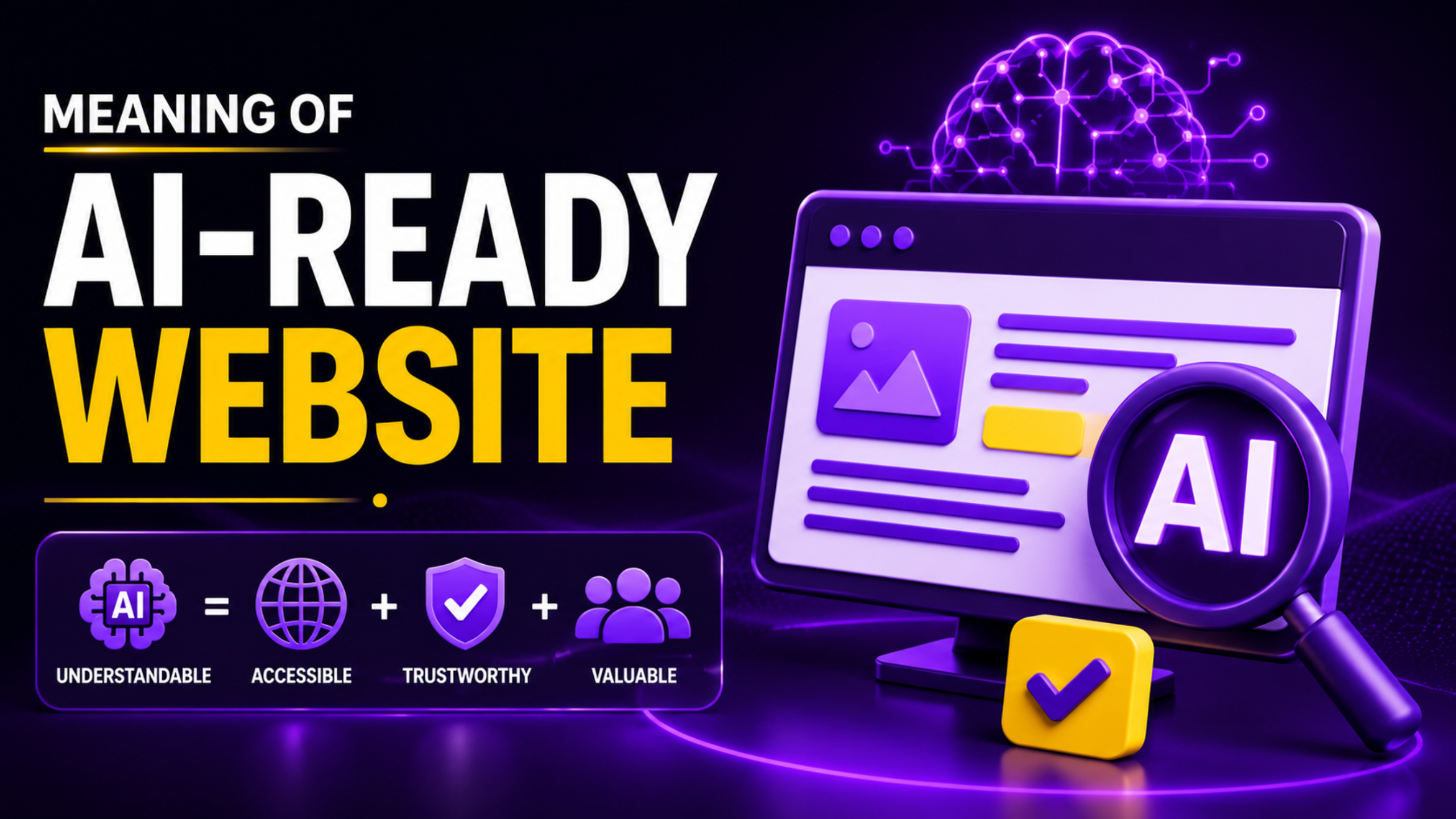
An AI-ready website is a website which is easily readable, understandable, trustworthy and referenceable by AI tools in answering user questions.
Human-oriented websites are designed in a way to impress human visitors with stunning designs, visual appeal, and branding. AI tools do not mind any of these features. What they need are clarity, structure, accuracy and credibility.
An AI-ready website, which is sometimes referred to as GEO optimization and Answer Engine Optimization, is a website designed in a manner where AI models can get specific and reliable information and then recommend your business to users who ask relevant questions.
It does not imply that you should have an unattractive website. The only implication here is that your website should have information that can be clearly understood, structurally and accurately provided by an AI model to recommend you.
Why Traditional SEO Is Not Enough
The concept of traditional SEO can be summed up in one sentence: get your page ranked for the keyword in Google. You optimize the title tag, sprinkle keywords through your content, and build links until you get the traffic.
And it still works. Google remains the leading search engine, and SEO generates a huge amount of traffic. But it is not the only thing that matters nowadays.
Unlike traditional SEO, where ranking for keywords is the main task, AI SEO aims at increasing the credibility of your website. Instead of trying to get the first position in a list, you are trying to be chosen by an AI model as a source to cite from when users ask questions from your niche.
Knowing the difference between ChatGPT SEO and traditional SEO is the key to creating your website for two platforms.
Step 1 - Create Your Content Around Questions
AI systems are designed to answer queries. The more specifically the information contained within your web pages answers queries made by your target clients, the higher the chances that an AI system will use your web pages while formulating its answers.
Examine all web pages on your site and try to find out - which query is answered by this particular web page? If you do not have a clear answer to this question, then this page should be re-written.
Use question-focused headings on all web pages. Queries formulated using words such as "what is," "how does," "why should," and "how to" correlate with the way queries are inputted into ChatGPT and Gemini. It is one of the most straightforward optimization methods for AI search.
Step 2 - Use Clear, Concise, Extractable Language
AI doesn’t actually read your site the way a human does. It looks for clear, precise data that can be extracted to answer the user’s question.
Lengthy, complicated paragraphs full of several topics all at once are hard for an AI to make sense of. Short, clear sentences focusing on one topic at a time are easy to extract.
When writing, think of how you’d explain something to a client who is intelligent but not an expert in your field - clear language, direct answers. This method works well for both human and AI reading.
In particular, when talking about Gemini SEO, Google's AI relies very heavily on content that fits Google’s Helpful Content Guidelines - which means writing for humans that is thorough and accurate will beat out writing for algorithms.
Step 3 - Create FAQ Sections for Your Website Pages
Creating FAQ sections for your pages is perhaps the single best thing you could do for AE (Answer Engine) optimization. The AI algorithms use the FAQ format of text content when developing their answers because the content is already in the Q&A format that they need.
Create an FAQ section for all of the major pages on your website. Put questions that your ideal customers actually have - not the ones that you would like them to ask. Make sure that both your question and the answer are very specific.
This one tweak will drastically increase your chances of being mentioned in ChatGPT and Gemini answers on your topic.
Step 4 - Establish Topical Authority With Content Clusters
An AI ready website does not consist of a single page or several blog posts; it is a collection of articles demonstrating expertise on the topic.
AI algorithms are programmed to recognize authoritative sites, and authority can only be created by going deep into the subject and covering it consistently. If you talk about a certain topic in ten different ways on several well-written pages, AI search engines will have no trouble recognizing your site as a reliable resource.
Create content clusters based on the main services provided by your website. For instance, if your website provides GoHighLevel services, create articles such as “how to automate on GHL”, “building funnels on GHL”, “how to configure GHL CRM”, “white labeling services on GHL” and others.
Step 5 - Get Mentioned in Reputable External Sites
AI does not learn from your website alone. It uses information from everywhere else on the internet - directories, review sites, industry publications, podcasts, YouTube, and social media.
Mention or citation or feature in any websites that have already been validated by AI models will make it more likely for you to get recommended. This is how GEO Optimization mirrors traditional SEO, where you work on building trust signals, rather than signals that affect rankings.
Contributions on industry blogs, mentions in any publications, listing in Clutch or G2, and guest spots on podcasts all contribute to this external reputation.
Step 6 - Structure Data through Schema Markup
Schema markup refers to the data that is placed into websites to help the search engines and the artificial intelligence understand exactly what the website is all about; it includes information such as the nature of the business, its services, frequently asked questions, reviews, and so on.
For building an AI-ready website, there are four key schema types that must be included; these include organization schema, service schema, FAQ schema, and review schema.
These provide structured information about your business in machine readable format that can be referenced by the AI tools with confidence. If you are unsure whether your website has schema markup or not, run a test using Google Rich Results Test tool.
Step 7 - Create and Develop a Good Review Profile
Reviews can be considered one of the most effective trust signals in the AI search ecosystem. Once the user turns to ChatGPT or Gemini for a recommendation for a service provider, the AI considers reputation information - and reviews play an integral part of this trust signal.
Regularly collect reviews from Google, Facebook, Trustpilot, Clutch, and all other directories related to your field if there are any. Answer all reviews, both positive and negative. Show your best reviews on your site with some real outcomes, not just praise phrases.
Businesses that have fifty good reviews from various trusted sources have much better chances of getting recommended by the AI compared to businesses having just a few testimonials.
Website Optimization for AI Search Checklist
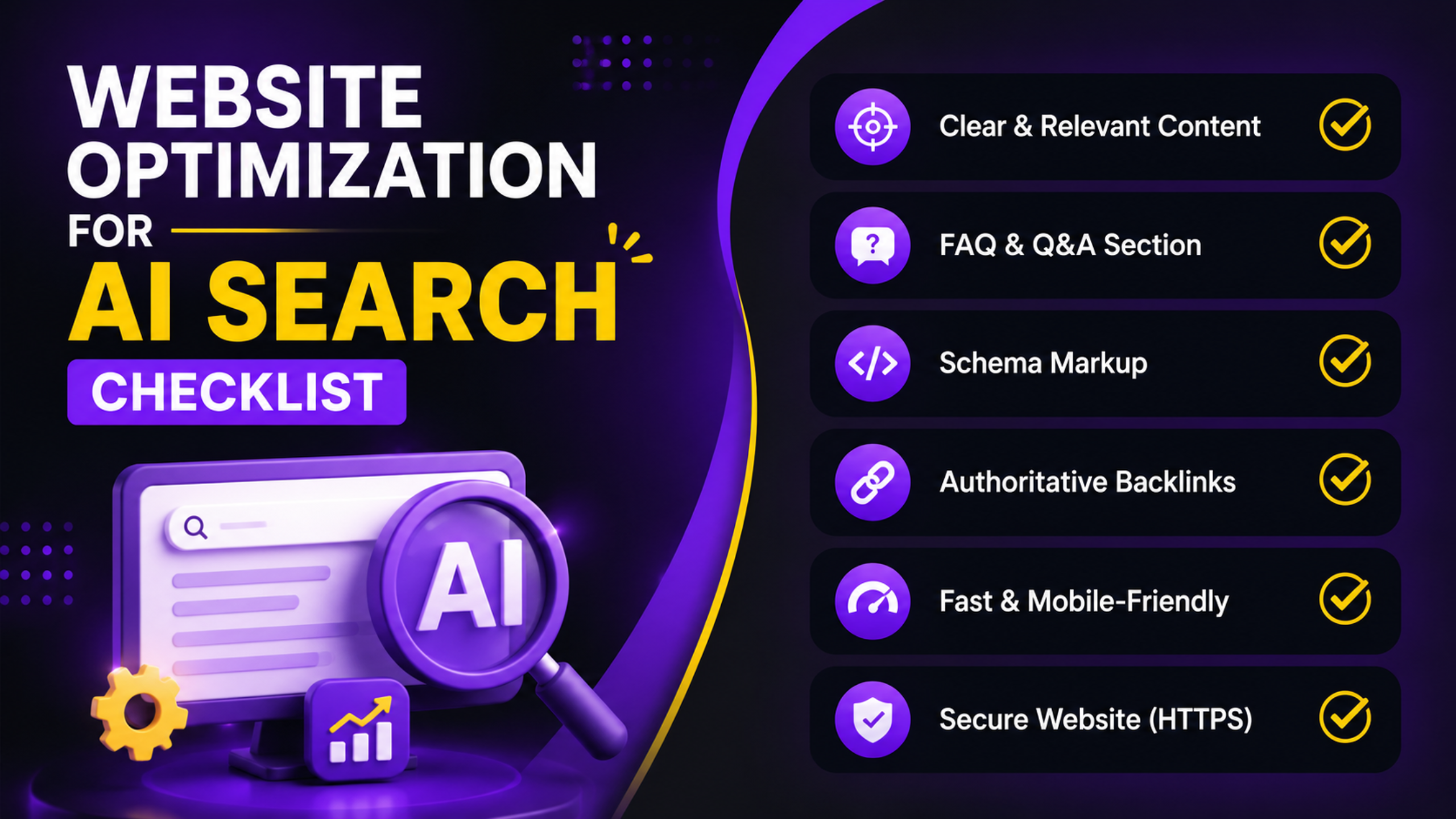
You can use the following checklist to evaluate your website against AI search criteria:
Each page designed with an answerable question in mind
Question-oriented H2 and H3 tags for all pages
Paragraphs concise and focused on a single idea only
FAQs included on each main service or landing page
Topic clusters created based on topic themes
Markups for organization, services and FAQs done
Google Business Profile filled and updated
At least three sites have your reviews
External guest posts or mentions on other trusted websites done
Social media pages active and linked to the main site
Linking between the relevant content pages set up
Page Speed score exceeding 70 on Google PageSpeed Insights mobile
Traditional SEO vs. GEO Optimization - Key Differences
What matters most about the comparison above is the fact that you do not have to choose between the two. In 2026, the smartest thing to do would be to create a website that meets the needs of both - the factors that make it a good choice for GEO optimization also make it better for SEO.
Conclusion:
The world of searches will never be the same again. ChatGPT, Gemini, and other AI-driven search engines have become integral to the way that your perfect customers find and vet service providers. If your website is not ready for them, you are missing a lot.
Creating an AI-optimized website does not mean doing everything all over again. Rather, it means putting the proper structure, content, and credibility to what you have already. Question-based content, FAQs, schema markup, topical authority, external mentions, and great reviews - these are just some of the building blocks of a website worthy of AI recommendation in 2026 and beyond.
Begin with the checklist provided above. Start making changes gradually, one area at a time. Remember - the companies that get featured by AI tools are not always the largest or oldest ones. They are the ones that created the most clear and credible web presence.
This is something any business can do.
Frequently Asked Questions
Q: How soon will an AI-optimized website get recommendations from ChatGPT or Gemini?
The majority of companies see their AI search visibility improve within three to six months after they have been regularly applying GEO optimization and Answer Engine Optimization tactics to their website and external profiles.
Q: Do I have to redesign my website to optimize it for AI searches?
No - most existing websites can be optimized for AI searches through adding FAQ sections, optimizing content organization, using schema markups, and creating external mentions without the need for website rebuilding.
Q: Is GEO optimization different from traditional SEO?
Yes - while the majority of principles overlap and there is a high level of similarity between the two, GEO optimization aims at receiving AI recommendations, while traditional SEO is based on keyword rankings.