


























Marketing Trends for 2027: 8 Changes to Prepare for win
Marketing Trends for 2027: What Businesses Need to Change Before It’s Too Late
Marketing is becoming easier to produce, but harder to make effective.
Businesses can now create social media posts, email campaigns, landing page copy, advertisements and customer follow-ups with AI tools in a fraction of the time it once took. Yet having more content does not automatically create more customers. More automation does not guarantee better customer experiences. And appearing in search results does not always mean a potential customer will visit your website.
That is the real challenge heading into 2027.
The marketing landscape is moving towards AI-assisted discovery, personalised customer journeys, automated business operations and stronger expectations around brand credibility. Businesses that treat these developments as separate trends may struggle to turn them into meaningful growth.
The opportunity is to build a connected marketing system: one that attracts the right audience, earns their trust, responds quickly, follows up consistently and measures what actually contributes to revenue.
Here are the most important marketing trends for 2027, what is changing, and what businesses should start doing now.
1. The Marketing Landscape Is Changing Faster Than the Tools Businesses Use
AI is no longer an experimental addition to marketing. It is becoming part of everyday business operations.
Adobe's November 2026 research, based on responses from 502 marketing professionals and 1,011 consumers in the United States, found that 74% of marketers expect to increase investment in AI tools and automation in 2027. The study also found that marketers expect the median share of automated marketing tasks to increase from 20% to 35% by the end of 2027.
These figures reflect marketers' expectations, not guaranteed outcomes. However, they show how quickly businesses are planning to integrate AI into their operations.
HubSpot's 2026 State of Marketing research also highlights AI-assisted personalisation, automation, brand-led content and adapting SEO for changing search behaviour as major priorities.
At the same time, Google's official guidance confirms that traditional SEO fundamentals remain relevant to AI-powered search experiences. Helpful content, crawlability, internal links, good page experience and accurate structured data still matter.
The important distinction is that marketing is not moving away from its foundations. It is adding new ways for customers to discover, evaluate and interact with businesses.
A website still matters. SEO Service still matters. Email still matters. Sales funnels still matter. But businesses need to connect these activities rather than manage each one in isolation.
2. What Is Becoming Less Effective in Traditional Marketing?
Some established marketing methods are not disappearing. They are simply becoming less effective when used without a broader strategy.
Publishing content without a clear purpose
It is not certain that publishing several blogs every month will ensure organic growth. In case such articles offer no new insight, reuse data available online, target irrelevant keywords or do not provide an answer to customer’s queries, it becomes difficult for them to get traffic.
Content should be developed around the customer’s problem or decision process.
Treating traffic as the main measure of success
A website receiving thousands of visits may still generate very few enquiries. Traffic without conversion analysis can create a misleading picture of performance.
Businesses should connect website activity with enquiries, qualified leads, appointments, sales and customer lifetime value.
Using generic automation
Sending the same message to every new lead may be easy to set up, but it ignores customer intent and context.
A person who requests a consultation should not receive the same sequence as someone who only downloads an introductory guide. Automation needs to respond to customer behaviour.
Building disconnected marketing systems
If forms on websites, marketing via emails, selling conversations, scheduling, and customer profiles all function independently, companies end up doing too much work manually.
There is the risk that leads will be lost, conversations may lack context, and it will become difficult for people to know which campaign is responsible for bringing customers.
The answer is definitely not getting more software. It is about connecting the existing ones.
3. Eight Marketing Trends Businesses Should Prepare for in 2027
The following trends combine developments already visible in 2026 with forward-looking expectations for 2027. Predictions are identified as such rather than presented as guaranteed outcomes.

Trend 1: AI Search Will Become an Important Part of Brand Discovery
Users have been turning to AI-enabled experiences to learn more about their products, services, and complex subjects.
Google's AI Overview and AI Mode have begun to transform certain paths of search experience. Rather than merely clicking on a list of web pages, users get an AI-produced description that is backed up with references to website pages.
One thing that becomes apparent from Google's documentation is that websites do not require a different set of AI ranking tricks to show up in such experiences.
For businesses, this means search visibility should extend beyond tracking a single keyword position.
What businesses should do:
Publish detailed content that answers specific customer questions.
Make important information accessible in readable website text.
Include clear explanations of services, pricing factors, processes and expertise.
Strengthen internal linking between related pages.
Build a consistent brand presence across relevant third-party websites.
Monitor organic traffic and AI-related visibility where reliable reporting is available.
Generative Engine Optimisation (GEO) and Answer Engine Optimisation (AEO) can be useful ways to describe this broader visibility effort. They should complement SEO, not replace it.
Trend 2: AI Will Move From Content Assistant to Workflow Assistant
For the last few years, many businesses have primarily used AI to generate ideas, write content and create marketing drafts.
The next stage is more operational.
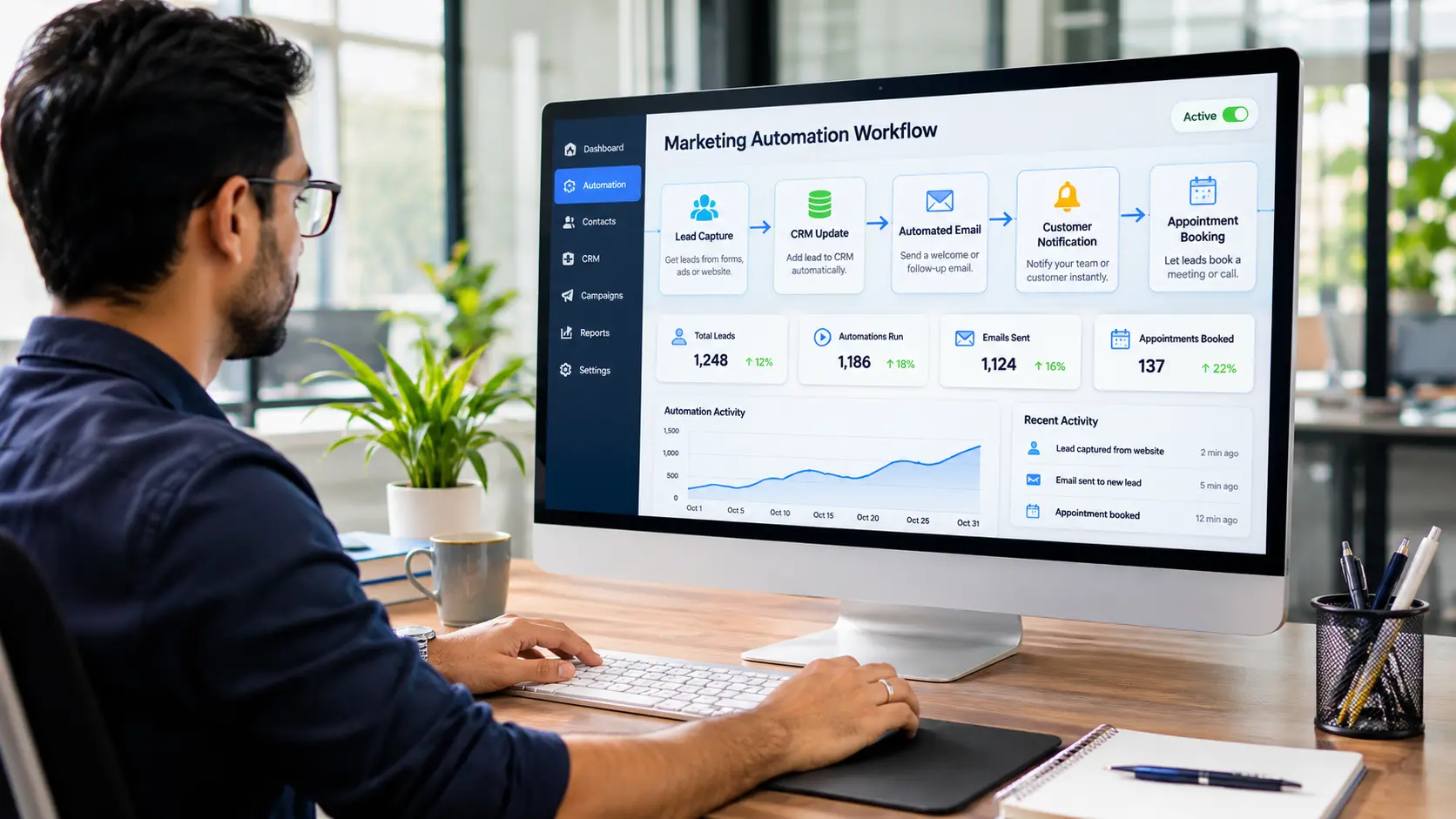
AI systems can increasingly support tasks such as responding to enquiries, qualifying leads, updating CRM records, summarising conversations, scheduling appointments and helping sales teams prioritise follow-ups.
Adobe's 2027 outlook identifies agentic AI and autonomous workflows as an important area of expected growth.
However, businesses should not automate every decision. An AI system that sends incorrect information or makes an inappropriate commitment can damage customer trust.
What businesses should do:
Start with repetitive, measurable processes. Define what the system can do independently, which actions need approval and when a human should take over.
For example, an AI receptionist could answer common questions and collect enquiry details, while a team member handles complex requests or sensitive conversations.
Trend 3: Personalisation Will Depend More on Customer Context
Using a customer's first name in an email is basic personalization. But it is now not enough to create truly personalized customer experiences.
True personalization takes into account how much a person has already done, what he or she has asked for, where a person stands in his or her journey, and what information a person needs next.
Someone who has scheduled a consultation requires a different kind of experience than someone who has not even replied to a previous inquiry.
According to HubSpot’s 2026 marketing forecast, personalization using artificial intelligence technology is one of the most prominent trends.
What businesses should do:
Organise CRM records around useful customer information.
Segment contacts by enquiry type, interest and buying stage.
Create follow-up messages based on actual actions.
Respect communication preferences and consent.
Review automated messages regularly to avoid irrelevant communication.
Personalisation should make customers feel understood, not monitored.
Trend 4: Brand Trust Will Become a Stronger Competitive Advantage
As AI-generated content becomes more common, customers will have more reasons to question whether marketing claims are accurate.
The November 2026 Adobe research revealed that 66% of those surveyed regarded accuracy and credibility as essential elements when determining the worthiness of the information for their consideration. The research also showed a disparity between what the marketers think will instill confidence and what the consumers think they need.
This has a direct implication for business websites and campaigns.
A company should not simply claim to be experienced, reliable or results-driven. It should provide reasons for customers to believe those claims.
What businesses should do:
Publish genuine customer reviews and testimonials with permission.
Explain who is behind the business.
Show real examples of work where disclosure is allowed.
Use accurate service descriptions and realistic promises.
Keep business information consistent across platforms.
Make contact details and next steps easy to find.
Trust is not a design element or a marketing slogan. It is built through consistent experiences.
Trend 5: First-Party Data Will Become More Valuable
It is important for organizations not to base their entire marketing efforts on those audiences that are available via rented platforms only.
Social media platforms, advertising networks, and search engines can alter their algorithms and costs, and an organization that has no direct link with its audience may find it hard to communicate consistently.
First-party data can be described as data gathered directly by an organization through genuine interaction with its customers.
A well-managed CRM can help businesses organise this information and use it responsibly.
What businesses should do:
Create useful reasons for visitors to subscribe or enquire.
Collect only information that is genuinely needed.
Maintain accurate CRM records.
Record communication preferences and consent.
Use customer data to improve service and relevance.
Avoid collecting information without a clear purpose.
The goal is not to collect as much data as possible. It is to understand customers better while respecting their privacy.
Trend 6: Short-Form Video and Human-Led Content Will Continue to Matter
AI can help businesses produce content faster, but speed alone does not create a recognisable brand.
Customers still want to understand the people, expertise and values behind a business. Short-form videos, demonstrations, expert explanations, customer stories and behind-the-scenes content can help create that connection.
The American Marketing Association's 2026 Future Trends report also highlights the importance of human creativity, cultural understanding and authentic storytelling as marketing becomes more automated.
What businesses should do:
Publish short videos answering common customer questions.
Show the process behind products and services.
Feature real team members and subject experts.
Turn useful long-form content into short, platform-specific pieces.
Use AI for editing and repurposing, while keeping the message authentic.
A business does not need to publish every day. It needs a repeatable content strategy that gives its audience a reason to pay attention.
Trend 7: Connected CRM and Omnichannel Follow-Up Will Matter More
Customers rarely move through a buying journey in a perfectly straight line.
Someone may discover a business through Google, visit its website, follow it on social media, ask a question through WhatsApp and book an appointment several days later.
If each interaction is managed separately, the business may lose valuable context.
A connected CRM helps bring customer information and communication activity into a more organised process.
Platforms such as GoHighLevel can support workflows involving contact records, pipelines, forms, calendars, email, SMS and automation. The right setup depends on the business's requirements and the tools it already uses.
What businesses should do:
Define the stages of the customer journey.
Connect website forms with the CRM.
Set up timely enquiry notifications.
Create follow-up sequences based on customer actions.
Track appointments, opportunities and sales outcomes.
Give staff a clear process for taking over conversations.
The objective is not to send messages through every available channel. It is to make every relevant interaction feel connected.
Trend 8: Marketing Performance Will Be Judged More by Revenue Than Activity
For years, businesses have used metrics such as impressions, clicks, followers and website sessions to understand marketing performance.
These metrics are useful, but they do not always explain whether marketing is producing profitable growth.
A campaign can generate many leads and still perform poorly if those leads are not qualified or do not convert.
In 2027, businesses should place greater emphasis on connecting marketing activity to commercial outcomes.
What businesses should do:
Track metrics such as:
Cost per qualified lead.
Lead-to-appointment conversion rate.
Appointment attendance rate.
Sales conversion rate.
Customer acquisition cost.
Revenue by marketing channel.
Customer retention and lifetime value.
This requires reliable tracking across the website, advertising platforms, CRM and sales process.
The most useful dashboard is not necessarily the one with the most charts. It is the one that helps a business make better decisions.
4. What Marketing Strategies Will Still Work in 2027?
It is tempting to assume that every new technology makes older marketing methods irrelevant. That is rarely how successful marketing evolves.

Several established approaches will continue to provide value when implemented properly.
Search engine optimization: Technical SEO, useful content, search intent, internal linking and relevant authority signals remain important. Google's guidance explicitly confirms that these fundamentals also apply to AI search features.
Professional websites: A website remains a central place where customers can understand a business, evaluate its services and take action. The difference is that websites need to offer more than attractive layouts. They need clear messaging, useful information and effective conversion paths.
Email marketing: Email remains useful for education, follow-up, onboarding and customer retention. Segmentation and relevance matter more than simply increasing sending frequency.
Sales funnels: Funnels still help businesses guide prospects from awareness to consideration and conversion. They become more effective when supported by relevant content, clear offers and consistent follow-up.
Customer relationships: Reviews, referrals, responsive support and repeat business remain valuable because customers make decisions based on more than advertisements.
The strongest strategy is not to abandon established channels. It is to improve how they work together.
5. How Businesses Can Build a More Effective Marketing System
Consider a hypothetical coaching business that receives enquiries through its website, social media and paid advertising.
Firstly, the business manages the requests manually. There is a quick reply for some requests but there are also unanswered messages. The appointment scheduling takes place in separate conversations and the owner lacks information on which campaigns produce revenue customers.
A more connected system could work differently:
A visitor discovers the business through search, social media or an advertisement.
The visitor lands on a focused website page with a clear service explanation.
An enquiry form captures the necessary information.
The CRM records the contact and assigns the enquiry to the correct pipeline stage.
An automated confirmation acknowledges the enquiry.
A relevant follow-up sequence provides useful information.
The prospect books an appointment through an integrated calendar.
The sales team receives the context needed for the conversation.
The opportunity is updated as the lead progresses.
Reporting connects the original marketing source with the final outcome.
This is a hypothetical workflow, not a claim about a verified client result.
Its value comes from reducing gaps between marketing, communication and sales. A business can implement parts of this system using an appropriate CRM, automation platform, website and scheduling tool.
6. What Businesses Should Start, Stop and Improve Before 2027
The most practical way to prepare is to review the current marketing operation rather than purchase every new tool.
Start doing
Use AI to support clearly defined business processes.
Create content around customer questions and genuine expertise.
Build a reliable first-party contact database.
Connect website enquiries with a CRM.
Measure qualified leads and revenue outcomes.
Review brand credibility across important online platforms.
Stop doing
Publishing generic content simply to meet a posting target.
Treating follower counts and traffic as the only success metrics.
Sending identical follow-ups to every contact.
Buying software without identifying the process it should improve.
Making marketing claims that cannot be supported.
Improve
Website messaging and conversion paths.
Search visibility across traditional and AI-assisted discovery.
CRM data quality and pipeline management.
Email and SMS segmentation.
Appointment booking and lead response processes.
Reporting between marketing and sales.
Invest in
Useful content and subject-matter expertise.
Website performance and conversion optimisation.
CRM implementation and workflow integration.
Responsible AI adoption.
Customer experience and team training.
Measurement systems that connect activity with outcomes.
7. A Practical 90-Day Marketing Preparation Plan
Businesses do not need to transform everything at once. A focused 90-day plan can create a strong foundation.
Days 1–30: Audit and prioritise
Review the website, SEO performance, lead sources, CRM, customer communication and existing marketing tools. Identify where enquiries are being lost and which activities produce meaningful results.
Choose two or three improvements based on business impact rather than trend popularity.
Days 31–60: Connect the essential systems
Improve important website pages, connect enquiry forms with the CRM, organise pipeline stages and introduce appropriate follow-up workflows.
Create clear rules for automation, customer consent and human handover.
Days 61–90: Measure and refine
Review lead quality, response time, appointment bookings, sales conversion and channel performance.
Improve underperforming pages and workflows. Remove unnecessary automation. Expand only the systems that are producing measurable value.
At the end of 90 days, the business should have a clearer understanding of its customer journey and a more reliable way to manage enquiries.
Conclusion: The Businesses That Connect Their Marketing Will Have an Advantage in 2027
The biggest marketing opportunity in 2027 is not simply using more AI, publishing more content or adopting another platform.

It is building a business system in which each part supports the next.
SEO makes people aware of a company. A good website makes them aware of the value of a company. Content gives you credibility. A CRM system keeps all the information about the customers organized. Automation helps in communicating timely. The sales process converts leads to customers.
These activities become more valuable when they are connected.
For businesses preparing for 2027, the priority should be to improve the foundations, adopt technology with a clear purpose and keep the customer experience at the centre of every decision.
If your business needs help connecting its website, sales funnels, CRM and marketing automation, explore Funnel Pandit's digital solutions. The right system should fit your business model-not force your business to fit the software.
Frequently Asked Questions
1. What are the major marketing trends for 2027?
Major trends are AI workflow, AI search visibility, personalized journey maps, first party data, human-generated content, integrated CRM systems, and revenue-centric performance metrics.
2. Will AI replace traditional digital marketing?
Not at all. The process of doing marketing is being reshaped by AI, but SEO, websites, email marketing, sales funnels, customer relationships, and branding strategies are still relevant. AI will serve as an aid where the process is enhanced by the technology and not the idea behind it.
3. Does SEO still matter in 2027?
It does. SEO continues to be important for making it possible for customers to find companies in search. Google itself mentions that its basic SEO techniques will apply to AI-enabled searches too. Companies need to have valuable content, accessibility, relevant internal links, and user experience.
4. What is Generative Engine Optimisation (GEO)?
Generative Engine Optimisation is the process of improving how your brand and content are recognised, referred to or quoted within the AI's responses. GEO works hand in hand with SEO through accurate information, reliable sources, valuable content and consistency with the brand.
5. How can small businesses benefit from AI marketing?
Small businesses may begin with easy tasks like content research, inquiry handling, appointment reminders, leads qualification, emails composition and reporting. It's important to start with simple repetitive tasks which add business value while maintaining the human factor.
6. Why will CRM and marketing automation matter in 2027?
CRM and marketing automation allows businesses to manage customer information, inquiries, sales opportunities and consistent follow-up. Proper configuration of this tool will reduce manual processes and increase visibility in the customer's journey.
7. How should companies prepare their marketing strategy for 2027?
It all starts with an analysis of the website, SEO, customer journey, lead management and reporting tools. Focus on areas where improvement should be done in terms of content, AI, CRM, personalisation and conversion tracking.