


























SEO for Coaches: How to Get More Coaching Clients Through Organic Search
Getting coaching clients shouldn’t depend entirely on posting on social media every day or continuously spending money on ads.
Social media can help build awareness, and paid advertising can generate leads quickly. But both usually require continuous effort or investment to maintain results.
SEO works differently.
Search Engine Optimization helps your coaching business appear when potential clients are actively searching on Google and other search platforms for the problems you solve, the services you provide, or guidance related to your expertise.
For example, someone might search:
“Business coach for entrepreneurs”
“Career coach for executives”
“How to choose a life coach”
“Leadership coaching for managers”
“Online fitness coach”
“Career change coaching”
“ADHD coach for adults”
These are not random visitors scrolling through a social feed. They are people actively looking for information, solutions, and in many cases, a coach.
In this guide, we’ll explain how SEO for coaching business works, how to find the right keywords, create content that ranks, build authority, optimize for AI-powered search, and ultimately turn organic traffic into coaching clients.
What Is an SEO Service for Coaches?
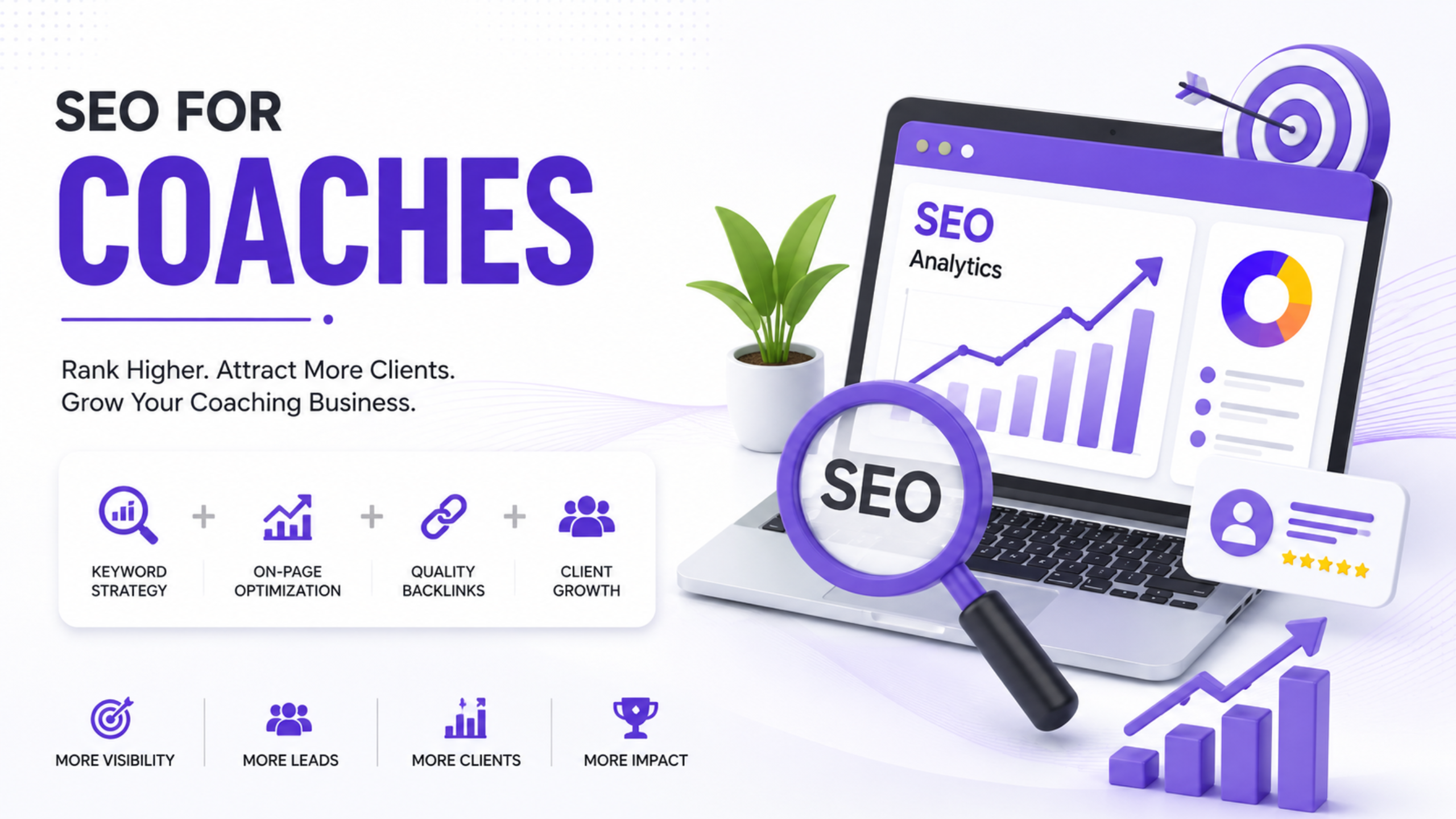
SEO for coaches is the process of optimizing a coaching website to appear when potential clients search for coaching services, solutions, or related information on Google and other search platforms. It includes keyword research, service-page optimization, content SEO, technical SEO, authority building, local SEO, and conversion optimization.
Suppose you are a career coach.
Potential clients might search:
How to change careers at 40
Career coach for senior executives
How to prepare for a career transition
Best career coaching programs
Career coach near me
A strong SEO strategy creates relevant pages and resources around these searches.
When your website consistently provides useful, trustworthy answers, search engines have more reasons to show your content to relevant users.
The objective isn’t simply to generate more website traffic.
The real goal is to attract the right people with the right search intent and guide them toward becoming leads and clients.
Why SEO Matters for Coaches
Most coaches face one major marketing challenge:
Consistency.
Social media requires frequent content.
Paid advertising requires a continuous budget.
Cold outreach requires constant prospecting.
Referrals can be unpredictable.
SEO can create a more sustainable acquisition channel because optimized content can continue attracting potential clients long after it has been published.
A useful article published today could potentially generate organic traffic, inquiries, email subscribers, and consultation bookings for months or even years if it continues to satisfy search intent.
That makes SEO particularly valuable for coaches who want to build long-term digital visibility instead of depending on a single marketing channel.
SEO Reaches People with Existing Intent
Consider the difference between these two situations.
Someone scrolling Instagram sees a coaching advertisement.
Another person searches:
“Business coach for small business owners”
The second person has significantly clearer intent.
They already know they have a need and are actively exploring a solution.
SEO helps position your coaching business at these high-intent moments.
SEO Builds Authority Before the First Conversation
Coaching is built heavily on trust.
Potential clients often want to understand:
Does this coach understand my problem?
Have they worked with people like me?
What is their methodology?
Can I trust their advice?
What results might I realistically expect?
High-quality SEO content can answer many of these questions before someone ever contacts you.
If a potential client discovers several useful articles, case studies, videos, or guides from your website, you begin building credibility before the sales conversation starts.
How to Do SEO for a Coaching Business
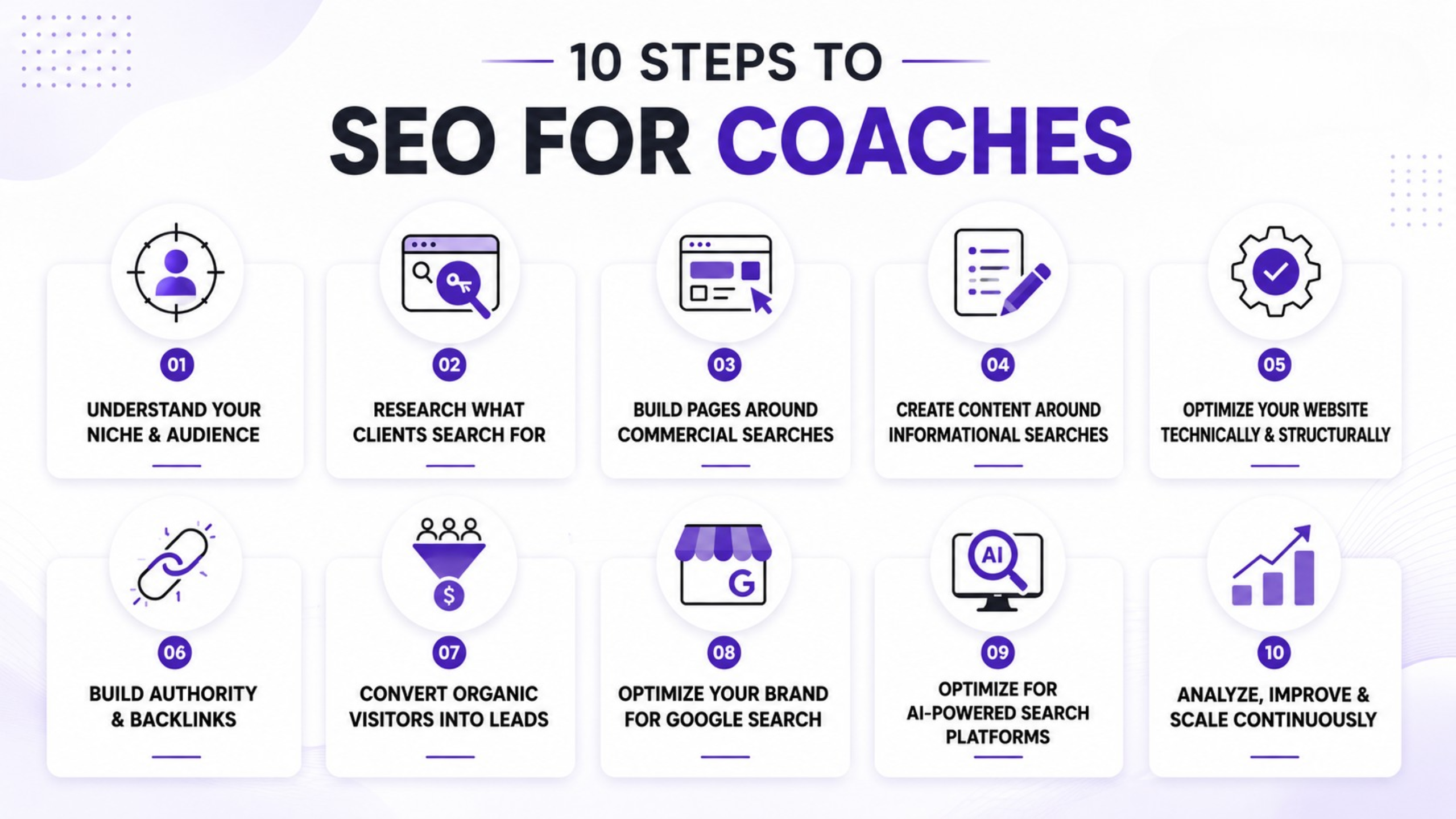
A successful coaching SEO strategy can be divided into several core stages:
Understand your niche and audience.
Research what potential clients search for.
Build service and landing pages around commercial searches.
Create useful content around informational searches.
Optimize your website technically and structurally.
Build authority and backlinks.
Convert organic visitors into leads.
Optimize your brand for Google and AI-powered search platforms.
Build Backlinks and Brand Authority
- Custom HTML/CSS/JavaScript
Turn SEO Traffic into Coaching Leads
Let’s break these down.
Step 1: Define Your Coaching Niche Before Doing Keyword Research
SEO becomes much easier when your positioning is specific.
A broad positioning such as:
“Life coach helping people improve their lives”
doesn’t give search engines or potential clients a clear understanding of your specialization.
Compare that with:
“Career coach helping senior professionals transition into leadership roles.”
Now there are several clear SEO opportunities:
Executive career coaching
Leadership transition coaching
Career coach for executives
Executive career change
Leadership development coach
The more clearly you understand your audience and the problems you solve, the easier it becomes to identify valuable search topics.
Before researching keywords, define:
Who you coach
What problems you solve
What transformation you provide
Whether you serve clients locally, nationally, or globally
Whether your coaching is 1-to-1, group-based, online, or in person
This becomes the foundation of your SEO strategy.
Step 2: Find Keywords Your Potential Clients Actually Search
Keyword research helps identify the words and questions people use when searching online.
There are generally two major categories you should focus on.
Commercial Keywords
These searches indicate that someone may already be looking for a coaching service.
Examples:
Business coach for entrepreneurs
Executive coach in London
Online career coaching
Leadership coaching services
Life coach for women
Fitness coaching program
These keywords should usually be targeted through dedicated service or landing pages.
Informational Keywords
These searches indicate that someone is researching a problem or looking for guidance.
Examples:
How to change careers
How to become more confident at work
How to improve leadership skills
Why do I feel stuck in my career?
How to stay accountable to fitness goals
These topics are ideal for blog posts, guides, videos, FAQs, and other educational resources.
The strongest SEO strategies target both informational and commercial intent.
Informational content attracts people earlier in their decision-making journey, while commercial pages capture people closer to hiring a coach.
Short-Tail vs. Long-Tail Keywords
A broad keyword might be:
“Business coach”
This could have significant search volume but also high competition and unclear intent.
A more specific keyword might be:
“Business coach for small business owners”
This is a long-tail keyword.
Long-tail keywords generally have lower individual search volume, but they can be extremely valuable because the search intent is more specific.
For newer coaching websites, targeting relevant long-tail searches can often be more realistic than competing immediately for broad, highly competitive terms.
Useful keyword research tools include:
Google Keyword Planner
Google Search Console
Ahrefs
SEMrush
Ubersuggest
Google autocomplete and related searches
ChatGPT and other AI tools for topic discovery
AI tools can help generate keyword ideas, but actual search demand and competition should ideally be validated using reliable SEO data.
Step 3: Understand Search Intent Before Creating Content

Finding a keyword is only the beginning.
You also need to understand why someone searched for it.
This is called search intent.
Search intent generally falls into four categories:
Informational
The user wants information.
Example:
“How to overcome imposter syndrome”
Commercial Investigation
The user is comparing possible solutions.
Example:
“Best executive coaching programs”
Transactional
The user is ready to take action.
Example:
“Hire executive coach”
Navigational
The user is searching for a specific person, company, or website.
Understanding intent determines what type of page you should create.
If Google primarily shows detailed guides for a keyword, creating a short sales page may not satisfy the search intent.
If Google primarily shows coaching service pages, publishing a 3,000-word informational article may also be the wrong approach.
Before creating a page, analyze what currently ranks and ask:
What does someone searching for this phrase actually want?
Then create the best resource for that intent.
Step 4: Build SEO-Focused Coaching Service Pages
Blogging gets most of the attention in SEO, but service pages are often closer to revenue.
Your website should have dedicated pages for your major coaching services rather than trying to rank one homepage for everything.
For example, an executive coaching business might create pages such as:
Executive Coaching
Leadership Coaching
Career Transition Coaching
CEO Coaching
Executive Coaching for Women
Online Executive Coaching
Only create separate pages when each service represents a genuinely distinct search intent and you can provide meaningful, unique content.
Each service page should clearly explain:
Who the service is for
Problems it helps solve
Your coaching methodology
What the process looks like
Expected outcomes
Your experience and credentials
Relevant testimonials or case studies
Frequently asked questions
Clear next steps
This helps both search engines and potential clients understand exactly what you offer.
Step 5: Create Helpful SEO Content

Once your core commercial pages are established, content can expand your organic reach.
The goal shouldn’t be to publish hundreds of generic AI-generated articles.
Focus on topics closely connected to the problems your ideal clients experience.
For example, a career coach could create content around:
How to know when it’s time to change careers
How to change careers without taking a pay cut
Career change at 40: where to start
How to prepare for an executive interview
How to negotiate salary after a career change
Each topic attracts a slightly different audience and search intent.
Over time, this creates topical authority.
Instead of having one random article about career coaching, your website becomes a comprehensive resource around career transitions.
That depth can strengthen your overall organic visibility.
How Long Should an SEO Blog Post Be?
There is no universal word count required to rank on Google.
A page should be as comprehensive as necessary to satisfy the search intent without adding unnecessary filler.
Some topics may require 1,000 words.
Others might require 2,500 or more.
Instead of asking:
“How many words should this article have?”
Ask:
“What information does someone searching this topic need before their question is fully answered?”
Then provide that information clearly.
Structure Content for Humans First
Good SEO content should be easy to scan and understand.
Use:
A clear H1 heading
Logical H2 and H3 sections
Short paragraphs
Bullet points were useful
Relevant examples
FAQs
Images, charts, or videos when they add value
Internal links to related resources
Avoid unnecessary keyword repetition.
Modern SEO is not about inserting the same keyword dozens of times.
Search engines have become much better at understanding topics, entities, context, and related concepts.
Write naturally while making the subject of each page unmistakably clear.
Step 6: Demonstrate Experience and Expertise
Generic information has become extremely easy to produce.
AI can create a basic article about almost any coaching topic within seconds.
That makes original expertise increasingly valuable.
Google’s quality guidelines emphasize concepts commonly referred to as E-E-A-T:
Experience
Expertise
Authoritativeness
Trustworthiness
For coaches, this can include:
Real coaching experience
Professional credentials
Original frameworks
Client case studies
Testimonials
First-hand observations
Specific examples
Research-backed insights
Transparent author information
Instead of publishing:
“5 Ways to Become a Better Leader”
you might explain a leadership framework you actually use with clients, provide examples of how it works, discuss common implementation mistakes, and explain when the framework may not be appropriate.
That creates content competitors cannot easily replicate.
Step 7: Optimize On-Page SEO
On-page SEO helps search engines understand what each page is about.
Important elements include:
SEO Title
Create a clear title that naturally includes the primary topic.
Example:
Executive Coaching for CEOs & Senior Leaders
H1 Heading
Each important page should have a clear primary heading describing its subject.
URL
Keep URLs short and descriptive.
Example:
/executive-coaching/
instead of:
/page?id=18373
Meta Description
Write a compelling summary that encourages relevant searchers to click.
Internal Links
Connect related pages across your website.
For example, an article about leadership burnout might link naturally to your executive coaching service.
Internal linking helps users navigate your content and helps search engines understand relationships between pages.
Images
Compress large images and use descriptive alt text where appropriate.
Schema Markup
Relevant structured data can help search engines better interpret your business and content.
Depending on the website, appropriate schema may include:
Organization
Person
Local Business
Service
Article
FAQ Page
Breadcrumb List
Schema should accurately represent visible page content rather than being added purely for ranking purposes.
Step 8: Fix Technical SEO Issues
Great content can still underperform if the website has technical problems.
Important technical SEO factors include:
Mobile usability
Page loading performance
Crawlability
Indexability
HTTPS security
XML sitemap
Robots.txt configuration
Canonical tags
Broken links
Redirect issues
Duplicate pages
Core Web Vitals
You should also monitor your website through Google Search Console.
Search Console can show:
Which queries generate impressions
Which pages receive clicks
Average search positions
Indexing problems
Crawl issues
Performance trends
This data helps identify what is already working and where additional optimization may produce results.
Step 9: Build Backlinks and Brand Authority
Google doesn’t evaluate your website in isolation.
It also considers signals from across the web.
Backlinks, links from other websites to yours, can help establish authority when they come from relevant, reputable sources.
Coaches can earn backlinks through:
Guest articles
Podcast appearances
Original research
Expert contributions
Industry directories
Professional associations
Partnerships
Useful statistics or resources
Digital PR
Quality matters far more than simply accumulating large numbers of links.
A relevant link from a respected industry publication can be more valuable than dozens of low-quality directory links.
Avoid buying large volumes of spammy backlinks.
Sustainable link building should strengthen both search authority and your broader brand reputation.
Step 10: Turn SEO Traffic into Coaching Leads
Traffic alone doesn’t grow a coaching business.
Conversion does.
Every important page should have a logical next step.
Depending on your business model, this could be:
Book a discovery call
Apply for coaching
Download a guide
Take an assessment
Join an email newsletter
Attend a webinar
View a coaching program
Someone reading an informational article may not be ready to book a consultation immediately.
That’s why lead magnets can be effective.
For example, a career coach might offer:
Free Career Change Readiness Checklist
A leadership coach might offer:
Leadership Skills Self-Assessment
A business coach might offer:
Business Growth Planning Template
The visitor receives something immediately useful, while you gain permission to continue the relationship through email.
This creates a simple SEO funnel:
Google Search → Helpful Content → Lead Magnet → Email Nurturing → Consultation → Client
Local SEO for Coaches
If you work with clients in a particular city or region, local SEO should be part of your strategy.
For example:
Life coach in Manchester
Business coach in New York
Executive coach in London
Career coach near me
Important local SEO activities include:
Optimizing your Google Business Profile
Keeping business information consistent
Collecting genuine client reviews
Creating useful location-specific pages where appropriate
Building relevant local citations
Earning links from local organizations
Adding locally relevant content
Avoid creating dozens of nearly identical city pages simply by replacing the city name.
Each location page should provide genuine value and accurately reflect where and how you provide services.
SEO for Coaches in the Age of AI Search
Search behavior is changing rapidly.
People no longer discover information exclusively through traditional Google results.
They increasingly use:
Google AI-powered search experiences
ChatGPT
Gemini
Perplexity
YouTube
Reddit
Other discovery and answer platforms
This has led to growing interest in concepts such as Generative Engine Optimization (GEO) and Answer Engine Optimization (AEO).
The objective is broader than ranking ten blue links.
You want your brand and expertise to be discoverable wherever potential clients search for answers.
Fortunately, many fundamentals overlap with traditional SEO.
AI systems tend to benefit from content and brands that demonstrate:
Clear expertise
Strong topical relevance
Original information
Consistent brand/entity signals
Trustworthy references
Mentions across authoritative websites
Well-structured, easily understood content
This means coaches should think beyond keywords.
Build a recognizable entity and authority footprint around your niche.
If you specialize in executive leadership coaching, your website, author profiles, external mentions, podcasts, articles, reviews, and other online signals should consistently reinforce that expertise.
Can You Use AI to Write SEO Content?
Yes, but AI should support expertise rather than replace it.
AI can help with:
Topic brainstorming
Keyword clustering
Content outlines
Research organization
FAQ discovery
Editing
Content repurposing
The problem begins when businesses generate large volumes of generic content without adding genuine experience or value.
If an AI tool can create essentially the same article without knowing anything about your coaching practice, the content probably lacks differentiation.
Add elements only you can provide:
Your experience
Your methodology
Your opinions
Real examples
Client insights
Original data
Unique frameworks
Use AI for efficiency.
Use human expertise for differentiation.
How Long Does SEO Take for Coaches?
SEO is generally a medium- to long-term strategy.
A new website should not expect meaningful rankings immediately after publishing a few articles.
Depending on factors such as competition, website authority, content quality, technical health, backlinks, and niche, noticeable progress may take several months.
Some lower-competition keywords can improve faster.
Highly competitive markets can take considerably longer.
Instead of focusing only on rankings, monitor multiple indicators:
Organic impressions
Keyword visibility
Organic clicks
Engaged visitors
Leads
Consultation bookings
Client acquisition
Revenue from organic search
Ultimately, SEO success should be measured by business impact, not vanity traffic.
Common SEO Mistakes Coaches Should Avoid
Targeting Keywords That Are Too Broad
Trying to rank immediately for “life coach” or “business coach” may be unrealistic for a newer website.
Start with more specific, high-intent opportunities.
Publishing Random Blog Topics
Every article should support a broader topical strategy.
Avoid blogging simply because you feel you “need to post something.”
Creating Content Without Search Intent
A keyword may look attractive based on search volume but still be irrelevant to your ideal clients.
Traffic without relevance rarely converts.
Ignoring Service Pages
Blog traffic is useful, but your money pages need SEO attention too.
Using AI Content Without Expertise
Generic AI-generated articles add little competitive advantage.
Ignoring Conversion Optimization
Ranking is only half the job.
Visitors need a clear path toward becoming leads.
Expecting Immediate Results
SEO compounds over time.
Constantly changing strategy after a few weeks makes it difficult to build momentum.
A Simple SEO Strategy for Coaches Starting from Zero
If you are starting with little or no organic visibility, keep the strategy focused.
Start by clearly defining your coaching niche and primary services.
Then identify the commercial keywords directly connected to those services and create strong, conversion-focused service pages.
Next, research the questions and problems potential clients search for before hiring someone like you.
Build a focused content plan around those topics.
A practical starting roadmap could be:
Fix major technical SEO issues.
Optimize your homepage and core service pages.
Research 10-20 high-value keyword opportunities.
Organize keywords into topic clusters.
Publish genuinely useful content consistently.
Build internal links between related pages.
Add strong author, experience, testimonial, and trust signals.
Earn relevant backlinks and external brand mentions.
Optimize key pages for conversions.
Track leads and revenue—not just rankings.
You don’t need hundreds of articles.
A smaller library of highly relevant, authoritative content can be far more valuable than hundreds of generic posts.
Should Coaches Hire an SEO Expert?
You can learn and implement basic SEO yourself. However, SEO becomes more complex when you need to manage keyword strategy, technical SEO, competitor analysis, content architecture, backlinks, conversion optimization, analytics, and emerging AI search visibility together.
Working with an SEO specialist may make sense if:
Your website gets little organic traffic.
You don’t know which keywords to target.
You publish content but it doesn’t rank.
Competitors consistently outrank you.
Your traffic doesn’t generate coaching inquiries.
You want to expand visibility across traditional and AI-powered search.
The key is to work with someone who understands that SEO for coaches is not simply about increasing traffic. It is about attracting potential coaching clients.
SEO Service for Coaches by Funnel Pandit
Funnel Pandit helps coaches and coaching businesses build organic search strategies designed around visibility, authority, and client acquisition.
Rather than focusing only on keyword rankings, the SEO strategy can cover the complete organic acquisition journey, from understanding what potential clients search for to helping those visitors take the next step.
Depending on the needs of the coaching business, this can include:
SEO strategy and competitor research
Keyword research and search intent mapping
Coaching service page optimization
SEO content strategy
Technical SEO
On-page SEO
Internal linking
Authority and backlink strategy
Local SEO
Google Search Console analysis
Conversion-focused SEO
AI search, GEO, and AEO optimization
The objective is simple:
Help your coaching business become visible when potential clients are actively searching for the expertise and services you provide.
If your coaching website is not generating enough qualified organic leads, an SEO audit can identify where opportunities are being missed and what should be prioritized first.
Get a Free SEO Audit for Your Coaching Website
Final Thoughts: Build an Organic Client Acquisition Asset
SEO is not a quick marketing hack.
It is the process of building a long-term digital asset around your expertise.
A strong coaching SEO strategy connects three things:
What your ideal clients are searching for + what you genuinely know + what your coaching business offers.
When those three align, your website becomes more than an online brochure.
It becomes a client acquisition system.
Start with your niche.
Research real search demand.
Build strong service pages.
Create genuinely useful content.
Demonstrate first-hand expertise.
Build authority.
Optimize for conversions.
And increasingly, make sure your brand can be understood and discovered not only through traditional Google search, but across the broader AI-powered search ecosystem.
The goal isn’t simply to rank.
The goal is to be found, trusted, and chosen.

Frequently Asked Questions
Q. What is SEO for coaches?
SEO for coaches is the process of optimizing a coaching website to appear in search results when potential clients search for coaching services, solutions, or related advice. It includes keyword research, content creation, on-page SEO, technical SEO, authority building, and conversion optimization.
Q. Does SEO really work for coaching businesses?
Yes. SEO can help coaches attract potential clients who are already searching for services or solutions related to their expertise. Unlike social media, where you need to continually publish to maintain visibility, well-ranked SEO content can generate relevant traffic and inquiries over a longer period.
Q. How long does SEO take to work for coaches?
SEO typically takes several months to show meaningful results, although the timeline depends on your niche, competition, website authority, technical health, content quality, and backlinks. Lower-competition keywords may improve sooner, while competitive coaching niches can take longer.
Q. How can coaches get clients from Google?
Coaches can attract clients from Google by targeting high-intent keywords, creating optimized service pages, publishing helpful content around client problems, building authority, and providing clear calls to action such as booking a consultation or requesting an assessment.
Q. What keywords should coaches target for SEO?
The best keywords depend on your coaching niche and ideal client. Instead of targeting only broad terms such as “life coach,” focus on specific searches such as “business coach for entrepreneurs,” “executive coach for senior leaders,” or “career coach for career change.” A good strategy combines commercial and informational keywords.
Q. Is local SEO important for coaches?
Local SEO is particularly useful for coaches who serve clients in specific cities or regions. Optimizing your Google Business Profile, earning genuine reviews, maintaining consistent business information, and creating relevant local content can improve visibility for searches such as “business coach near me” or “executive coach in [city].”
Q. Can coaches use AI to create SEO content?
Yes. AI can assist with research, topic ideas, outlines, editing, and content optimization. However, coaches should add their own experience, methodologies, client insights, examples, and expertise rather than publishing generic AI-generated content without meaningful human input.
Q. What are GEO and AI SEO for coaches?
Generative Engine Optimization (GEO) and AI SEO focus on improving a brand’s visibility across AI-powered discovery and answer platforms. For coaches, this means building clear expertise, authoritative content, consistent brand signals, credible mentions, and original insights that help both traditional search engines and AI systems understand who you are and what topics you specialize in.
Q. Should coaches hire an SEO expert?
Hiring an SEO expert can make sense when you lack the time or expertise to handle keyword research, technical SEO, content strategy, authority building, analytics, and conversion optimization yourself. The right SEO strategy should focus not just on increasing traffic, but on attracting relevant prospects who could realistically become coaching clients.